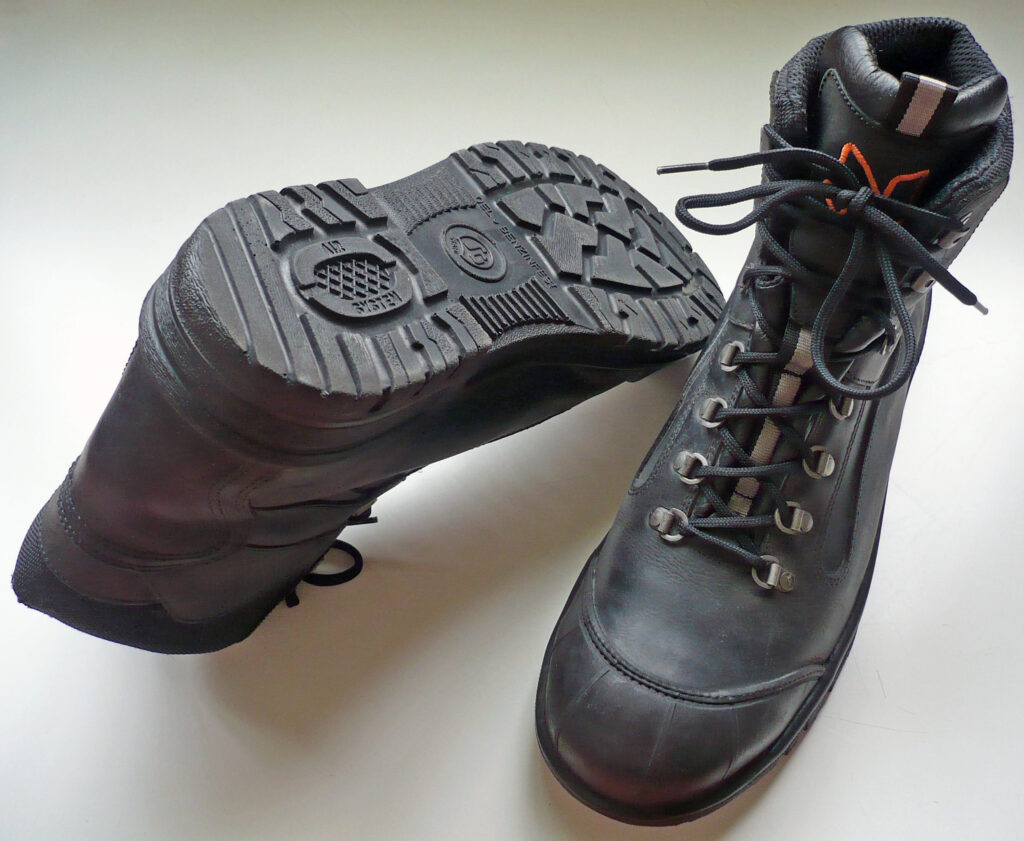
Quick answer: Choose fieldwork boots in this order: required protection, walking surface, water exposure, then fit. Get your employer’s footwear requirements before buying. Protective footwear must match the identified hazards; a rugged appearance or waterproof label is not enough. Among acceptable options, choose a pair that fits properly and suits the actual ground conditions. (osha.gov)
This guide is for beginning surveying, mapping and environmental field technicians, outdoor workers and crew leaders. It uses U.S. OSHA general-industry requirements as its regulatory starting point—not as a universal rule for every assignment. Confirm the requirements that apply to your workplace.
No products were tested for this article. Manufacturer specifications below illustrate how to read a footwear description, not which model to buy.
1. Get the site requirements before shopping
Ask your supervisor for the footwear policy and the protection required for your assignment. Under OSHA’s general-industry PPE rule, employers assess hazards, select suitable protection, communicate that selection and ensure proper fit. Buying your own boots does not remove the employer’s responsibility to check their adequacy. (osha.gov)
OSHA’s foot-protection rule addresses falling or rolling objects, objects piercing the sole, and certain remaining electrical hazards after other necessary protective measures. These are different problems, so “work boots required” is not a sufficiently clear shopping instruction. (osha.gov)
Before spending money, ask:
-
Which footwear standard and protective features are required?
-
Are there additional rules for boot height, materials or sole design?
-
Must the exact model receive approval before purchase?
-
Does the assignment include another site with different requirements?
-
Is footwear supplied, reimbursed or covered by an allowance?
Clarify payment rather than assuming either party pays. OSHA’s general-industry PPE payment rule includes exceptions, including certain non-specialty safety-toe footwear permitted off the jobsite. (osha.gov)
Practical check: Send the exact model number and manufacturer specification sheet for approval—not just a photograph or shopping-page headline.
2. Separate protective features from outdoor features
A boot can be waterproof without providing the impact, puncture or electrical protection your site requires. Conversely, protective footwear still needs to suit the walking conditions. CCOHS recommends selecting both the appropriate hazard rating and an appropriate sole. (ccohs.ca)
Use these questions to interpret the requirement:
|
Feature to confirm |
Question to ask |
|---|---|
|
Protective toe |
What impact and compression protection does the site require? |
|
Puncture resistance |
Is protection against objects penetrating the sole required? |
|
Metatarsal protection |
Is the top of the foot, between the toes and ankle, exposed to injury? |
|
Electrical or static protection |
Which exact type does the employer specify? |
|
Waterproof construction |
What exposure is expected, and what does the manufacturer claim? |
The first four questions concern distinct workplace hazards; do not treat one feature as proof of the others. (osha.gov)
For example, Merrell’s Moab 3 Waterproof description lists a waterproof membrane, a rubber toe cap and a molded nylon arch shank. Those descriptions are not evidence of a workplace safety-toe or puncture-resistance rating. The opened specification does not list those ratings. (merrell.com)
By contrast, Red Wing’s EcoLite #2286 specification explicitly lists an aluminum safety toe, puncture resistance and electrical-hazard protection. It also identifies the footwear as Oxford height. This demonstrates why you must check the whole specification: listed protective features do not settle a separate site-height requirement. It is not a recommendation for outdoor fieldwork. (redwingshoes.com)
3. Match traction to the surface, not the slogan
Write down the surfaces you expect: muddy ground, gravel, rock, wet concrete or metal platforms. Include likely contaminants, such as water, mud or oil.
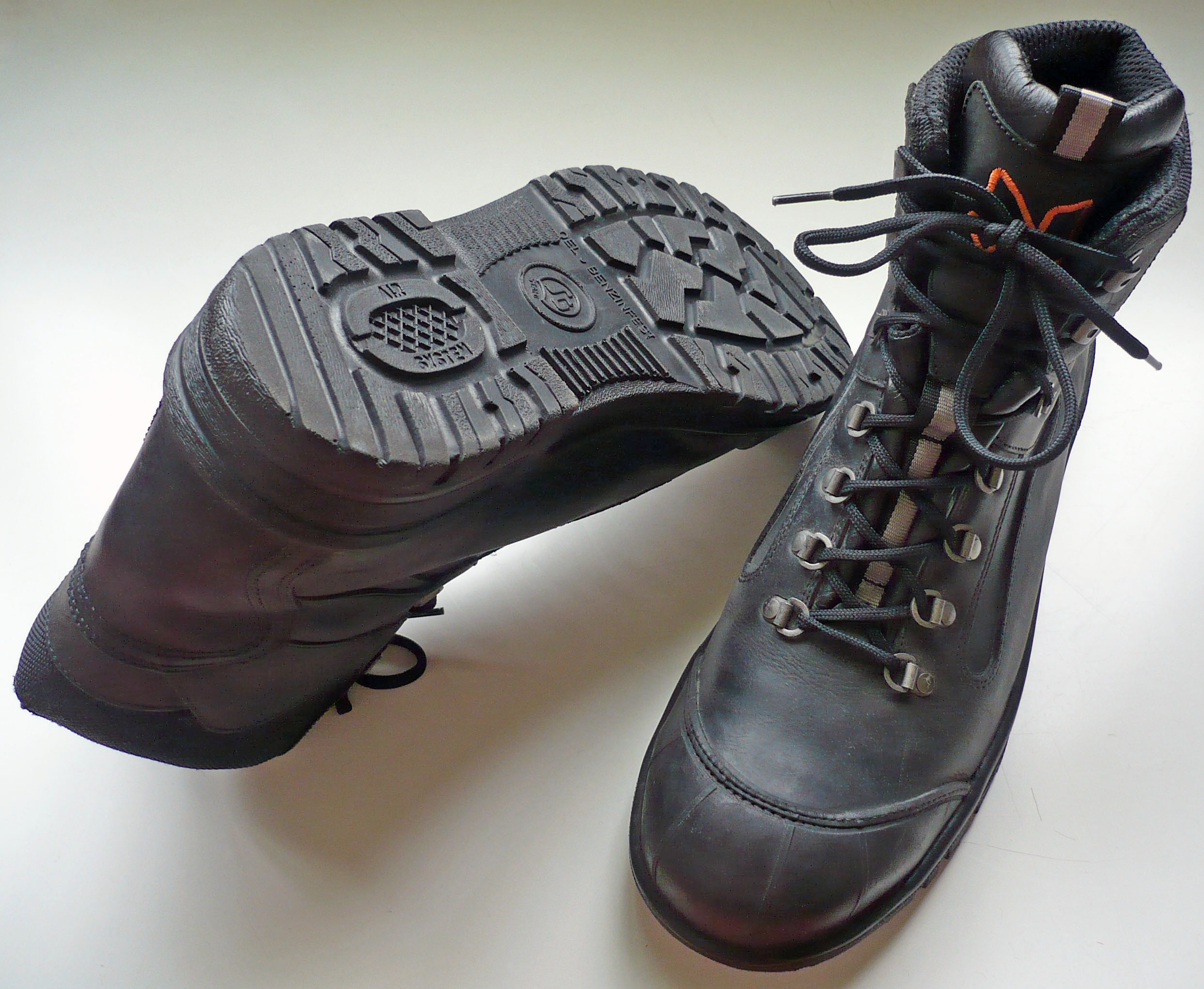
The UK Health and Safety Executive explains that both sole compound and tread pattern affect slip resistance. More open tread generally works better outdoors or with solid contaminants. It also warns that footwear performing well in wet conditions may not perform well with oil or other contamination. (hse.gov.uk)
Ask the supplier:
-
What surfaces and contaminants was this footwear tested against?
-
Are the results relevant to our workplace?
-
Can the employer arrange a controlled footwear trial?
-
How should the tread be cleaned and inspected?
Common mistake: Reading “oil-resistant” as “slip-resistant on oil.” HSE distinguishes these claims: oil resistance describes resistance to damage from oil, not necessarily grip. (hse.gov.uk)
Treat impressive-looking tread as a reason to investigate, not proof of performance. HSE recommends workplace-relevant trials rather than selection from brochure descriptions or laboratory results alone. Any trial should be employer-managed; do not deliberately test grip on a dangerous slope or slippery structure. (hse.gov.uk)
4. Decide whether keeping water out is the priority
Describe the exposure precisely. Wet grass, rain, splashes and standing water are not interchangeable shopping requirements.
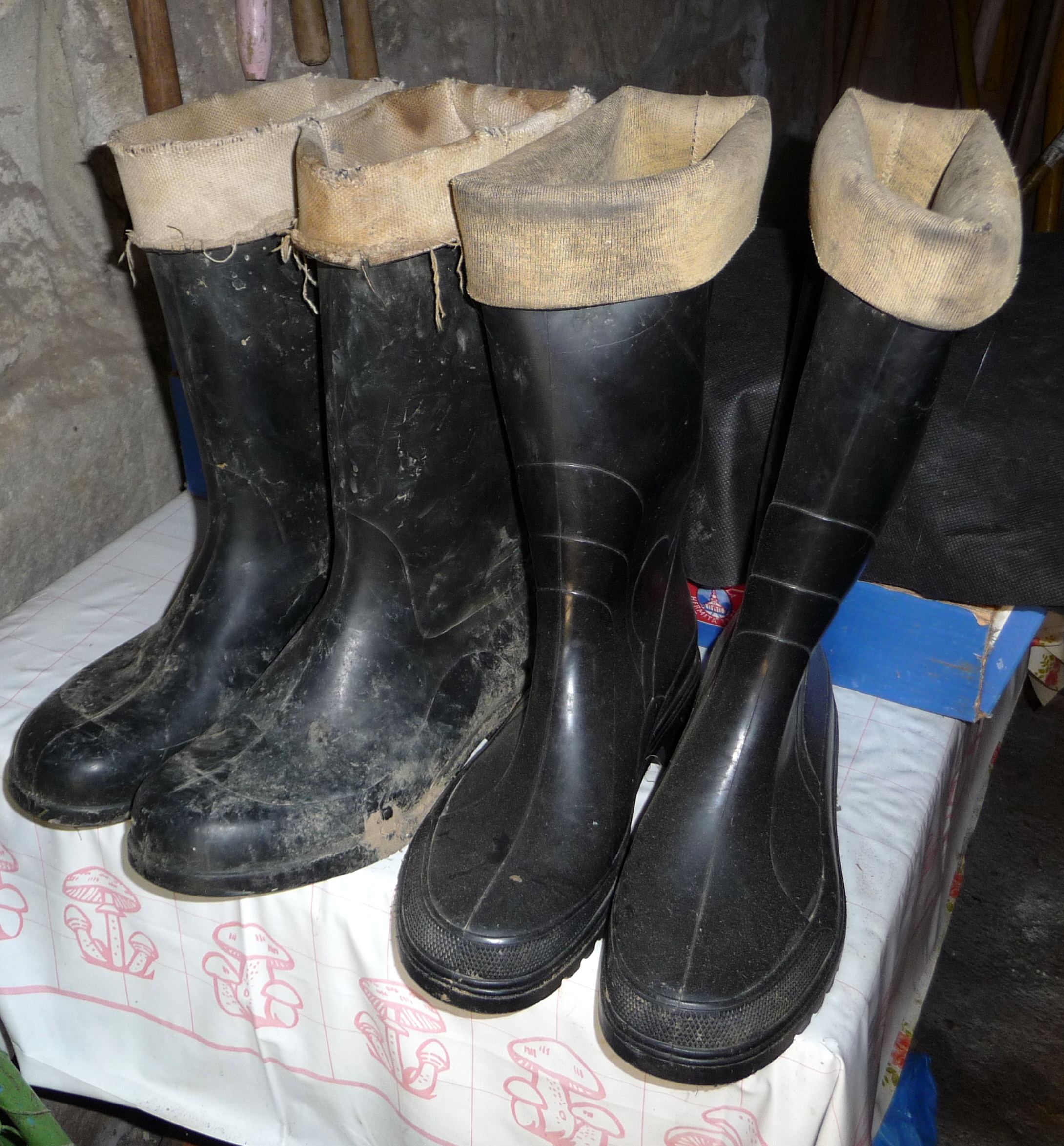
KEEN’s explanation of its waterproof membrane distinguishes waterproof construction from water-resistant materials and water-repellent surface treatments. It also acknowledges a breathability trade-off and notes that water can enter through a footwear collar. (keenfootwear.com)
Use that distinction when narrowing your options:
-
Rain or wet vegetation: Investigate waterproof construction, while still checking protection and fit.
-
Warm, mostly dry walking: Compare permitted non-waterproof options rather than automatically choosing a membrane.
-
Repeated shallow water exposure: Ask whether the employer specifies waterproof pull-on boots or another system.
-
Unknown liquids or contamination: Obtain a hazard-specific selection; do not use a general waterproof claim as approval.
CCOHS includes water, irritating or corrosive substances, temperature and walking conditions among the exposures to assess when choosing footwear. (ccohs.ca)
Also ask, “What happens if these are wet inside at the end of the day?” The sources reviewed do not establish a dependable cross-model drying-time comparison. Do not infer an overnight drying guarantee from “breathable” or “quick-drying.” Ask about care instructions and plan for the actual facilities available between shifts.
5. Check fit with your working socks and inserts
Try both boots on later in the day, have both feet measured, and fit the larger foot. CCOHS advises against buying tight footwear with the expectation that it will stretch. The heel should be held securely while the toes have room to move. (ccohs.ca)
Bring the socks and any approved supports you intend to use at work. CCOHS specifically recommends allowing for these during fitting and checking with the manufacturer whether added inserts affect protection. (ccohs.ca)
Use this fitting routine:
-
Put on both boots with the intended socks and approved inserts.
-
Fasten them as you would for work.
-
Walk around rather than judging them while seated.
-
Check heel movement, toe space and pressure across the forefoot.
-
Reject a size or shape that pinches or allows persistent sliding.
For safety-toe footwear, pay attention to the cap edge. CCOHS says a cap cutting into the foot indicates an incorrect size or style. Changing the boot shape may be more appropriate than simply moving up a size. (ccohs.ca)
A useful shop-floor question is: “Can I compare another width or last?” Last refers to the form used to shape the footwear. Treat the answer as a fitting option, not a promise that a particular brand will suit your feet.
Before committing the pair to a full field day, ask how an approved fit trial can be arranged without compromising site requirements or the seller’s return conditions.
6. Compare footwear for three different assignments
These are illustrative selection scenarios, not tested recommendations.
|
Assignment |
Start with |
Then compare |
|---|---|---|
|
Muddy sampling location |
Employer-approved protection and expected water exposure |
Tread spacing, fit and cleaning requirements |
|
Long walking day on established routes |
Permitted footwear and the actual walking surface |
Heel hold, toe room, comfort and whether waterproofing is needed |
|
Site with mandatory protective footwear |
Exact standard, protection and height requirements |
Terrain suitability, water protection and fit among compliant options |
This sequence combines hazard-based selection, surface-specific traction and fitting principles. It does not assume a particular occupation always requires the same boots. (osha.gov)
Worked example: a mixed sampling-and-compound day
Assume a technician will walk through muddy ground to take samples, then enter a compound whose written policy requires safety-toe, puncture-resistant, ankle-height footwear.
The technician has two candidates:
-
Candidate A: A waterproof hiking boot whose documentation does not list the required protective ratings.
-
Candidate B: An ankle-height protective boot whose documentation lists the required ratings, but whose tread suitability and fit remain unconfirmed.
Candidate A is not ready for approval: its waterproof construction does not document the stipulated protection. Candidate B moves to the next checks; it has not automatically “won.”
The technician should submit Candidate B’s specification for employer approval, ask the supplier about the muddy conditions, and complete the fit check. If it fails those checks, look for another compliant option.
The lesson: Do not score a missing mandatory feature against a comfort advantage. Verify required protection first, then compare suitability.
7. Inspect, clean and dry boots between field days
Before departure, look for sole cracks, damaged uppers, exposed protective caps and other defects. CCOHS recommends repairing or replacing worn or defective footwear, and OSHA’s general-industry PPE rule prohibits using defective or damaged PPE. (ccohs.ca)
After work:
-
Follow the boot manufacturer’s cleaning instructions.
-
Remove debris from the tread.
-
Remove removable insoles when the care instructions permit.
-
Open the footwear for ventilation.
-
Dry it using the approved method before storage.
LOWA’s care guidance recommends removing insoles and drying its footwear in a well-ventilated room away from heat sources. It warns against drying wet leather beside radiators, ovens or in hot cars. Follow the instructions for your own materials rather than transferring one leather-care treatment to every boot. (lowa.com)
Report an impact or sole-penetration event even when the boot appears intact. CCOHS notes that damage may be invisible and advises replacement after such an event. (ccohs.ca)
Keep a simple footwear record: model number, approval, care instructions and any reported damage. Before a new assignment, recheck the requirements rather than assuming yesterday’s approval covers a different site.
Final buying check: Can you document the required protection, explain why the sole suits the ground, confirm comfortable fit, and follow a realistic cleaning-and-drying routine? If one answer is missing, resolve it before purchase.